Minimum Order Quantities Explained: What First-Time B2B Buyers Should Expect
Minimum order quantities, or MOQs, often confuse first-time B2B packaging buyers. This guide explains what MOQs mean, why they exist, and how to navigate them confidently.
What Minimum Order Quantity Actually Means
MOQ refers to the smallest quantity a supplier will produce or sell in a single order. This threshold exists because manufacturing setup costs make very small orders financially impractical for suppliers.
Understanding this helps first-time buyers see MOQs not as arbitrary barriers, but as a reflection of genuine production economics behind bulk packaging manufacturing.
Why MOQs Vary Across Products
MOQs differ significantly based on material complexity, customization level, and production method. Standard catalog items typically carry lower MOQs than fully custom, branded packaging requiring dedicated production runs.
A simple kraft box might have a modest MOQ, while a custom-printed, uniquely shaped container could require a substantially higher order volume to justify setup costs.
How MOQs Affect First-Time Buyers
New businesses often worry that MOQs force them into ordering more inventory than they can realistically use quickly. This concern is valid and worth addressing directly with potential suppliers before committing.
Some suppliers offer lower MOQs for standard, non-customized items specifically to accommodate smaller businesses or first-time buyers testing a new product line.
Strategies for Managing MOQ Requirements
Several practical approaches help first-time buyers navigate MOQ constraints:
- Start with standard catalog items carrying lower MOQs than custom options
- Partner with other businesses to split a larger bulk order
- Negotiate phased delivery of a single large order across multiple shipments
- Choose suppliers specifically known for flexible MOQ policies
These strategies reduce the financial risk of committing to a large order before confirming product-market fit.
Calculating Whether an MOQ Makes Sense
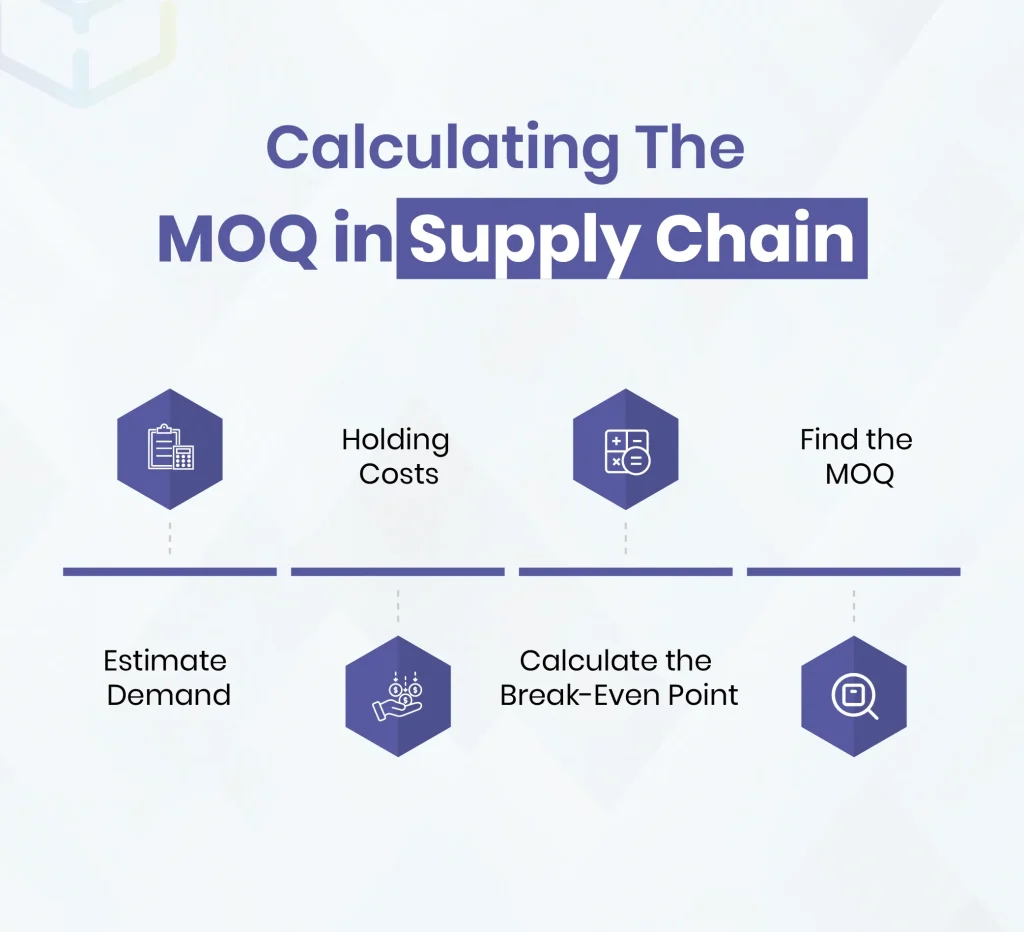
Before committing to an MOQ, calculate your expected usage rate and storage capacity. If the MOQ significantly exceeds a reasonable six-month supply, consider whether a different supplier or product might better fit your business stage.
This calculation prevents both wasted capital tied up in excess inventory and storage challenges from housing more product than your business can efficiently manage.
Negotiating MOQs With Suppliers
MOQs aren’t always fixed in stone. Suppliers sometimes offer flexibility for promising long-term relationships, especially if a buyer commits to regular, smaller reorders instead of one large upfront purchase.
Approaching this conversation transparently, explaining your business stage and growth plans, often yields more flexibility than simply asking for a lower MOQ without context.
Asking About Sample Order Options
Before committing to a full MOQ, ask whether a supplier offers small paid sample orders separate from their standard minimum. This lets you test product quality without committing to a large bulk purchase upfront.
Not every supplier offers this flexibility, but those who do provide first-time buyers a lower-risk way to validate product fit before scaling into their full minimum order quantity.
How Raw Material Sourcing Affects MOQ
Certain raw materials, like specific eco-friendly fibers or specialty coatings, require suppliers to purchase minimum quantities from their own upstream providers. This upstream constraint often directly shapes the MOQ passed down to buyers.
Understanding this connection helps buyers see why some eco-friendly options carry higher MOQs than conventional plastic alternatives, since sustainable raw material supply chains are often less established at scale.
Comparing MOQ Approaches
Standard catalog items | Lower MOQ, faster fulfillment | Less customization |
Custom branded packaging | Strong brand identity | Higher MOQ, longer lead time |
Split orders with partners | Access to bulk pricing | Requires coordination |
Phased delivery agreements | Manageable storage needs | May cost slightly more |
Balancing Storage Costs Against MOQ Discounts
Higher order volumes often come with better per-unit pricing, but this benefit only holds if you have adequate storage space and won’t face degradation or waste before using the full order across your operations.
Weigh potential savings from a larger MOQ against your actual storage costs and product shelf life, since a lower price per unit means little if a portion of the order goes unused or degrades in storage before it can ever be used.
Planning for Future Growth
As your business scales, MOQs that once felt restrictive may become easily manageable within your growing order volume. Revisit supplier agreements periodically as your business needs evolve.
Building a relationship with a supplier who can scale alongside your business avoids the disruption of switching vendors entirely once your order volume outgrows initial MOQ constraints.
Common MOQ Mistakes to Avoid
- Committing to an MOQ without calculating realistic usage timelines
- Assuming all products from one supplier carry identical MOQs
- Failing to ask about phased delivery options for large orders
- Not negotiating despite having room to discuss terms
Avoiding these mistakes protects new businesses from cash flow strain tied to excess inventory.
Working With MOQ-Flexible Suppliers
EcoTurtles offers a range of MOQ options across standard and custom packaging, helping first-time B2B buyers find an entry point that matches their current business stage and growth trajectory.
Final Thoughts
MOQs reflect genuine production economics, not arbitrary supplier restrictions. Understanding them helps first-time buyers negotiate confidently and choose products that fit their actual business needs and growth stage.
Calculate your real usage needs, ask direct questions, and build a supplier relationship that scales alongside your growing business.